Equality as Theft: The Fairness That Steals
How Uniform Raises Rob the People They Claim to Protect
There is a particular kind of cruelty that arrives dressed as kindness. It announces itself with warm language about fairness and inclusion, wraps itself in the administrative robes of efficiency, and presents a check that looks, on the surface, identical to everyone else’s. Only when you hold it up to the light do you realize what it actually says.
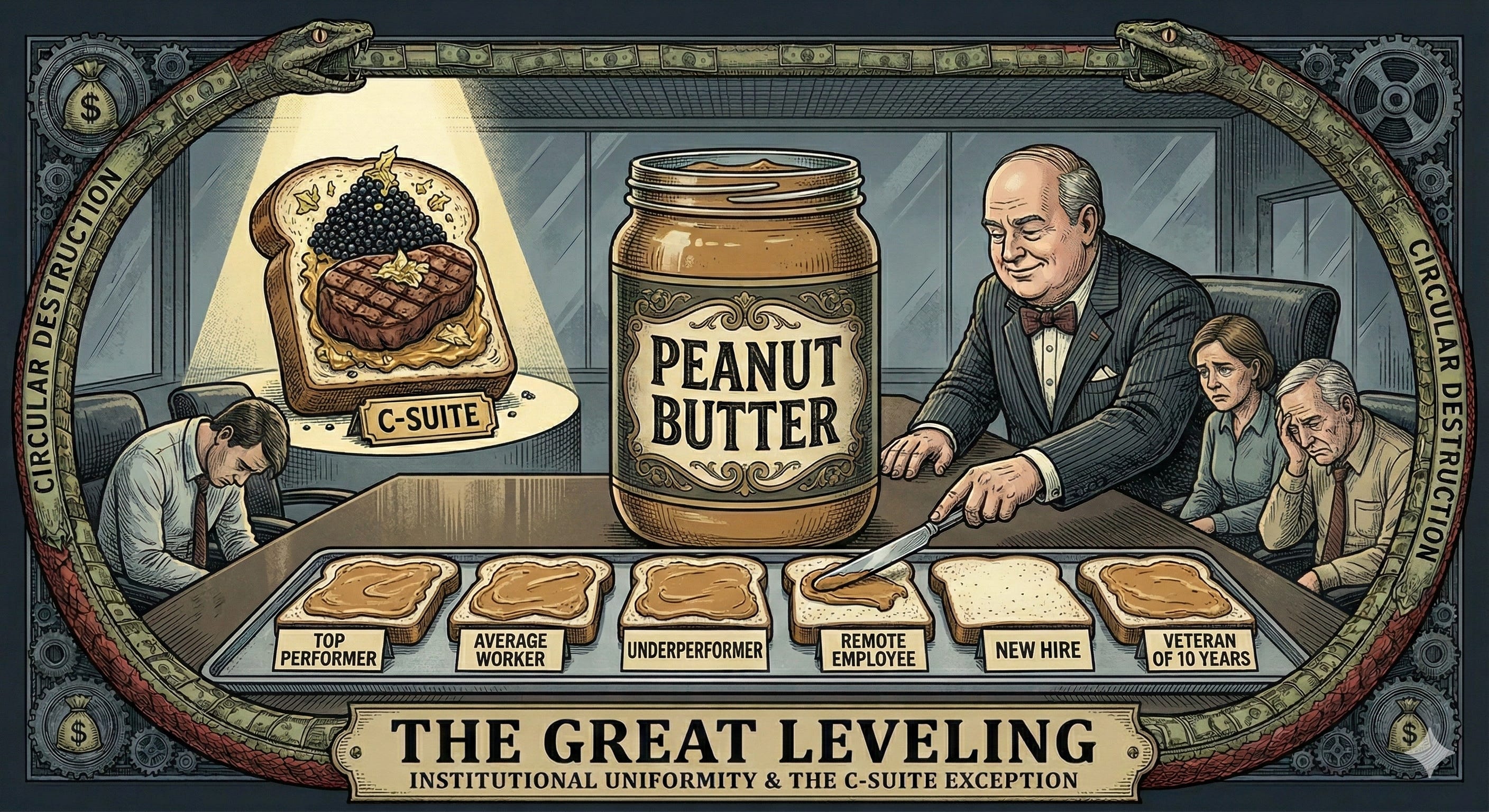
Welcome to the era of the peanut butter raise.
The Spreadsheet That Ate the Soul
Here is how the story gets told in boardrooms across America: the budget is tight, the economy is uncertain, performance reviews are riddled with bias, and — most importantly — somebody in Finance needs to close the books without a surprise. The solution is elegant in its brutality. Everyone gets the same percentage. The high performer who has been carrying three people’s workload since the last round of layoffs. The mid-level manager who has spent two years perfecting the art of being present without contributing. The underperformer who has made a small religion out of minimum acceptable effort. Same envelope. Same number. Same message.
The message, of course, is that none of you are particularly distinguishable.
The term itself — peanut butter — is borrowed from the image of spreading a condiment evenly across a surface. It is a domestic metaphor, almost cheerful, designed to make a structural decision about human value sound like something you might do on a Sunday morning. Organizations didn’t decouple pay from performance. They spread the peanut butter. The language is doing a great deal of work here.
And the strategy is no longer confined to struggling companies buying time before the next round of restructuring. Data from 2026 compensation surveys reveals that well over half of top-performing organizations — companies that exceeded their own revenue targets — are either using or actively considering uniform, across-the-board raises. This is not a crisis tactic anymore. It has become a management philosophy.
The Bureaucratic Seduction
To be fair to the architects of this system, the logic is not entirely without merit. It just happens to be the logic of a hospital administrator, not a talent strategist.
Performance management, as it is practiced in most organizations, is genuinely broken. The annual review cycle has always been a theater of subjectivity — managers rating people based on the last three weeks of visibility, on who sat closest to the corner office, on the unspoken social contracts of proximity and likability. In hybrid and remote environments, this problem has metastasized. The employee working remotely in disciplined, measurable excellence frequently receives a smaller raise than the one who spent the year making sure their calendar was visible on the shared conference room screen.
If performance ratings are inherently biased and the merit differentials they produce are functionally arbitrary, the argument goes, then why not simply eliminate the pretense and give everyone the same thing?
It is an administratively coherent argument. It dramatically simplifies the HR workflow. It eliminates the painful manager-employee negotiation where someone has to justify why their 4.1 out of 5 translated into 3.2% while their colleague’s 4.3 translated into 4.0%. It converts labor cost from a variable — dangerous to financial planners — into a fixed, predictable line item. It is, as one set of analysts drily observed, the path of least resistance.
And paths of least resistance have a way of leading somewhere you did not intend to go.
Who Gets Saved, and Who Gets Buried
The people who genuinely benefit from the peanut butter model are, in large part, the people who were already struggling. Frontline workers, entry-level employees, and those earning wages that were never going to win the merit lottery in the first place. When the mathematical alternative is a “meets expectations” raise so small it evaporates against the monthly grocery bill before it ever reaches the checking account, a uniform increase that at least tracks inflation is a concrete act of financial dignity.
There is nothing cynical about acknowledging this. For the worker at the bottom of the wage structure, the difference between a 2% merit raise and a 3.5% across-the-board increase is not a philosophical debate about organizational culture. It is rent.
But every system designed to protect one group from harm manages, with stunning consistency, to inflict a different and less visible harm on another. The peanut butter model is no exception.
The person it quietly devastates is the one who believed the bargain. The one who accepted a role that was perhaps below market because they were told performance drove advancement. The one who volunteered for the difficult project, mentored the junior staff, delivered the result that made someone else’s presentation possible. The one who operates from the foundational, almost naive assumption that the relationship between effort and reward is, at some level, honest.
When that person opens their compensation letter and discovers they received the exact same increase as the colleague who has been on a performance improvement plan for six months, they do not experience it as fairness. They experience it as a correction. The organization has told them — not in words, but in the most precise language available to it — that their discretionary effort was worth exactly nothing beyond the baseline.
Some of them accept this quietly and recalibrate accordingly. They stop volunteering. They stop mentoring. They stop delivering at the level that made them exceptional and begin performing at the level that the compensation system has now officially endorsed: adequate.
Others start updating their résumés.
The Math That No One Wants to See
There is a technical consequence to the uniform percentage model that organizations tend to ignore until it becomes a staffing crisis, and it goes by the antiseptic name of salary compression.
Here is how it works in practice. The market for new talent does not wait for your internal compensation cycle to catch up. While an organization is applying a flat 3.5% raise to its existing staff, the external market is moving on its own timetable, driven by supply and demand, geographic pressures, and the specific scarcity of whatever skill set you most need. New hires arrive with market-rate offers. Tenured employees receive percentage increases calculated against a base that was already falling behind.
The result, over time, is the system turned on its head. The five-year veteran finds themselves earning less than the person hired last quarter to do the same job. The manager who built the department now trains someone brought in at a starting salary above their own. This is not hypothetical. It happens in organizations everywhere, and it is one of the most corrosive forces in workplace culture — not because of the money itself, but because of what the money represents. It represents the organization’s answer to the question: what is your history with us worth?
The answer, in a compressed pay structure, is: less than nothing.
The Gender Trap Hidden in the Formula
There is a more troubling dimension to the peanut butter approach that its advocates rarely advertise, and it involves an assumption so embedded in the logic of percentage-based raises that it is almost invisible until someone names it explicitly.
When you apply a uniform percentage increase to an existing salary base, you are treating that base as a legitimate foundation — a fair and accurate reflection of the employee’s market value. But what if the base was never fair to begin with?
Research examining how managers distribute raises under different framing conditions found something damning. When compensation budgets were framed as a percentage, managers anchored individual raises to existing salaries. Because men, on average, earned more than women performing the same work at the same level, the percentage formula mechanically delivered larger dollar increases to the men — not through any conscious act of discrimination, but through the pure mathematics of compounding a pre-existing inequity. The gender pay gap didn’t just persist. It widened.
When the same budget was framed as a flat dollar amount to distribute, the gap shrank. The anchoring shifted from legacy salary to equitable distribution.
This is the hidden scandal of the peanut butter model: it presents itself as the antidote to bias while serving as its most efficient delivery mechanism. Every uniform percentage raise is a vote for the proposition that whatever inequities existed in the salary structure before this moment are officially endorsed, accelerated, and carried forward into the next fiscal year. And the year after that.
Organizations that have invested in DEI language, equity audits, and inclusion task forces should sit with that for a moment.
The Theater of the Exception
What makes the spectacle complete is what happens at the top of the house while the peanut butter is being applied to everyone else.
Starbucks is instructive here. The company introduced a flat 2% uniform raise for its salaried North American workforce as part of a cost-control initiative — a raise that, in an environment of persistent inflation, functions less as compensation growth and more as the gracious acknowledgment that you still have a job. The raise was universal, non-negotiable, and pointedly divorced from individual contribution.
The package assembled to attract the CEO from a competitor, meanwhile, included millions in performance-based equity grants, contingent on specific operational milestones.
This is not a contradiction. It is the system working exactly as designed. Meritocracy remains very much alive in corporate structures — it simply operates on a tiered basis. The executives who are deemed irreplaceable receive compensation architectures of remarkable sophistication: base salaries, short-term incentives, long-term equity, signing bonuses, and golden parachutes calibrated to individual leverage. The workforce that makes the product and serves the customer receives the peanut butter.
The justification for this arrangement — that executive talent is uniquely scarce and therefore commands unique pricing — is the exact same argument that justifies merit-based pay for high-performing individual contributors. The logic is coherent on one floor of the building and abandoned on all the others.
What the Performance of Fairness Costs
Organizations adopting the peanut butter strategy often believe they are making a safe choice. And in the short term, they are. The budget closes cleanly. The HR workflow simplifies. Nobody has to have a difficult conversation about why one person’s effort was valued and another’s was not. The surface of the organization remains smooth.
Beneath the surface, the talent calculus is quietly shifting.
The workers with the most options — the ones whose skills are genuinely portable, whose résumés attract external offers, whose expertise creates value wherever they take it — are the ones running the numbers. They are looking at the gap between what internal compensation delivered and what the external market will pay. They are noting that the distance between staying and leaving has narrowed to a conversation and a LinkedIn message. They are concluding, with the dispassionate logic of people who were told to bring their analytical skills to work every day, that the organization has officially told them what they are worth.
And then they act on the information.
What remains, over time, is a workforce that the compensation system successfully retained: people for whom the peanut butter was sufficient, either because they lacked alternatives, or because they had already optimized their output to match what the system was willing to reward.
This is not a metaphor. It is a documented organizational outcome. And it is the quiet cost of a strategy designed to avoid difficult decisions by making the most consequential decision of all: that everyone, regardless of contribution, is worth exactly the same.
A Final Note on the Language
There is a reason it is called the peanut butter raise and not the mediocrity subsidy, even though both descriptions are accurate. Language in corporate environments is never accidental. The cheerful domestic metaphor performs the same function as the language of rightsizing and workforce optimization and strategic restructuring — it makes a deliberate organizational choice sound like a natural, even pleasant, inevitability.
The spread goes on. The bread remains inert. Everyone gets their share.
Whether that share represents fairness or the administrative convenience of treating human beings as interchangeable — that question is left, carefully and by design, unasked.
The Free Voices Circle publishes analytical essays on corporate structures, workplace dynamics, and the systems that shape professional life. If this resonated with you, share it with someone who is still waiting to be told what they are actually worth.