
The Architecture of Systemic Paralysis: A Research Paper
A Comparative Analysis of the OSS Simple Sabotage Field Manual and the Rockefeller General Education Board Framework
This research paper was conceptualized and curated by Manuel Muñoz, Jr., with both research and drafting assistance provided by Google Gemini AI.
1. Introduction: The Isomorphism of Sabotage and Compliance
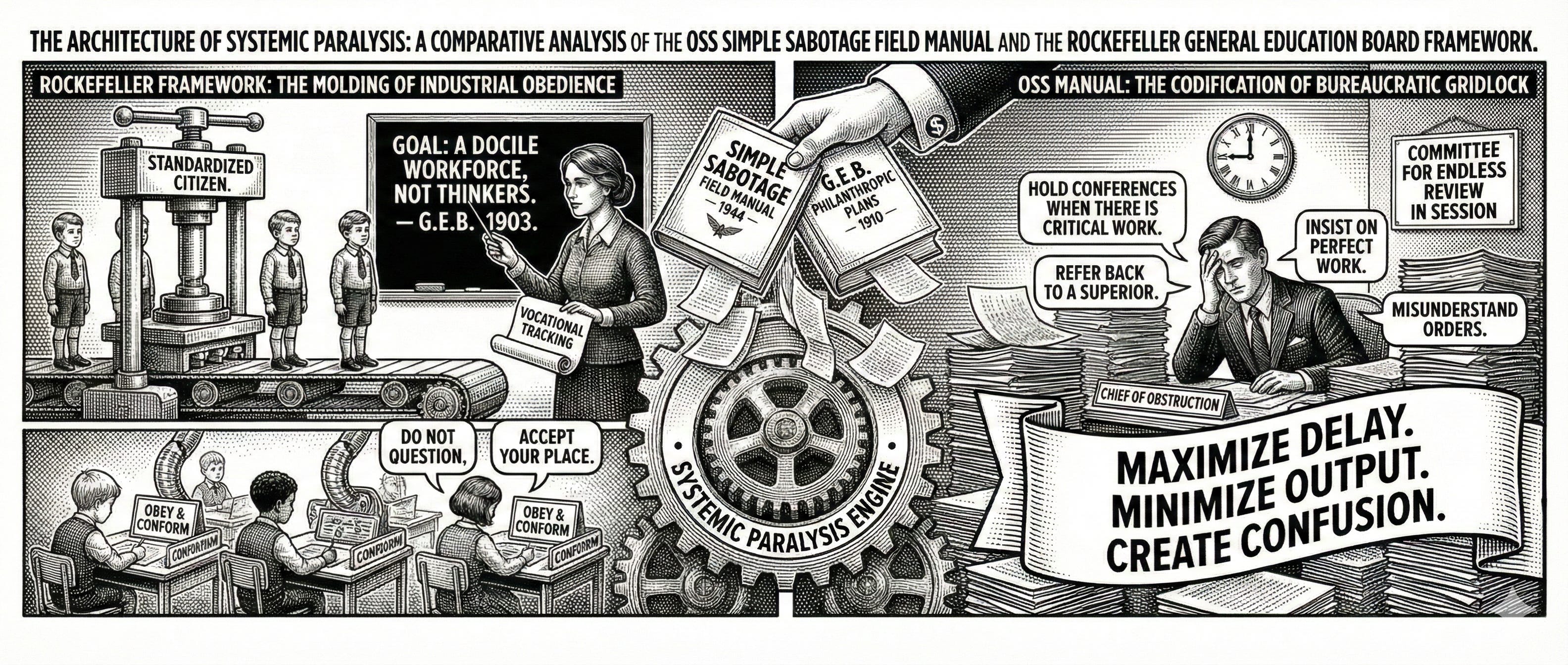
The modern American workplace is currently experiencing a profound crisis of engagement and productivity, characterized by phenomena widely labeled as “quiet quitting,” “innovation stagnation,” and “bureaucratic paralysis.” While contemporary analysis often attributes these pathologies to recent shifts in generational attitudes or technological disruptions, a rigorous historical and structural analysis suggests a much deeper, more systemic origin. This report posits that the fundamental dysfunctions of the modern corporate environment are the direct, albeit unintended, consequences of a century-long educational experiment initiated by the General Education Board (GEB) in the early 20th century. By juxtaposing the foundational documents of this educational framework—specifically the writings of Frederick T. Gates and the principles of scientific management—with the tactical doctrines of the Office of Strategic Services (OSS) Simple Sabotage Field Manual of 1944, a disturbing isomorphism emerges. The behaviors codified by the OSS as effective methods for dismantling enemy productivity from within are structurally identical to the behaviors conditioned in students through the “hidden curriculum” of the factory-model school system.
This analysis argues that the compulsory schooling model, designed to produce a docile industrial workforce, effectively institutionalized the very mechanisms of sabotage that the OSS later identified as weaponized inefficiency. The insistence on rigid channels of communication, the fragmentation of attention through arbitrary time constraints (the bell schedule), the suppression of divergent thinking in favor of the “one right answer,” and the mandated passivity of the student body have created a workforce that is psychologically predisposed to bureaucratic obstructionism. What was intended to ensure “perfect docility” in 1902 has metamorphosed, in the complex knowledge economy of 2025, into a culture of “malicious compliance” and “learned helplessness.” The “good student” of the 20th century has become the “unintentional saboteur” of the 21st, executing a program of organizational interference not out of malice, but out of successful conditioning.
To understand this trajectory, we must first dissect the origins of the educational machine that shapes the cognitive and behavioral patterns of the populace. We must interrogate the explicit intent of its architects, who sought not to create “philosophers or men of letters,” but a predictable, manageable citizenry.1 We must then map these educational inputs against the sabotage tactics outlined by the OSS to demonstrate the precision with which the school system replicates the conditions of interference.3 Finally, we will trace these converging lines into the modern office, identifying the specific “sick symptoms” that plague today’s organizations—from the tyranny of the meeting to the paralysis of permission culture—as the inevitable harvest of seeds sown in the kindergarten classroom.
