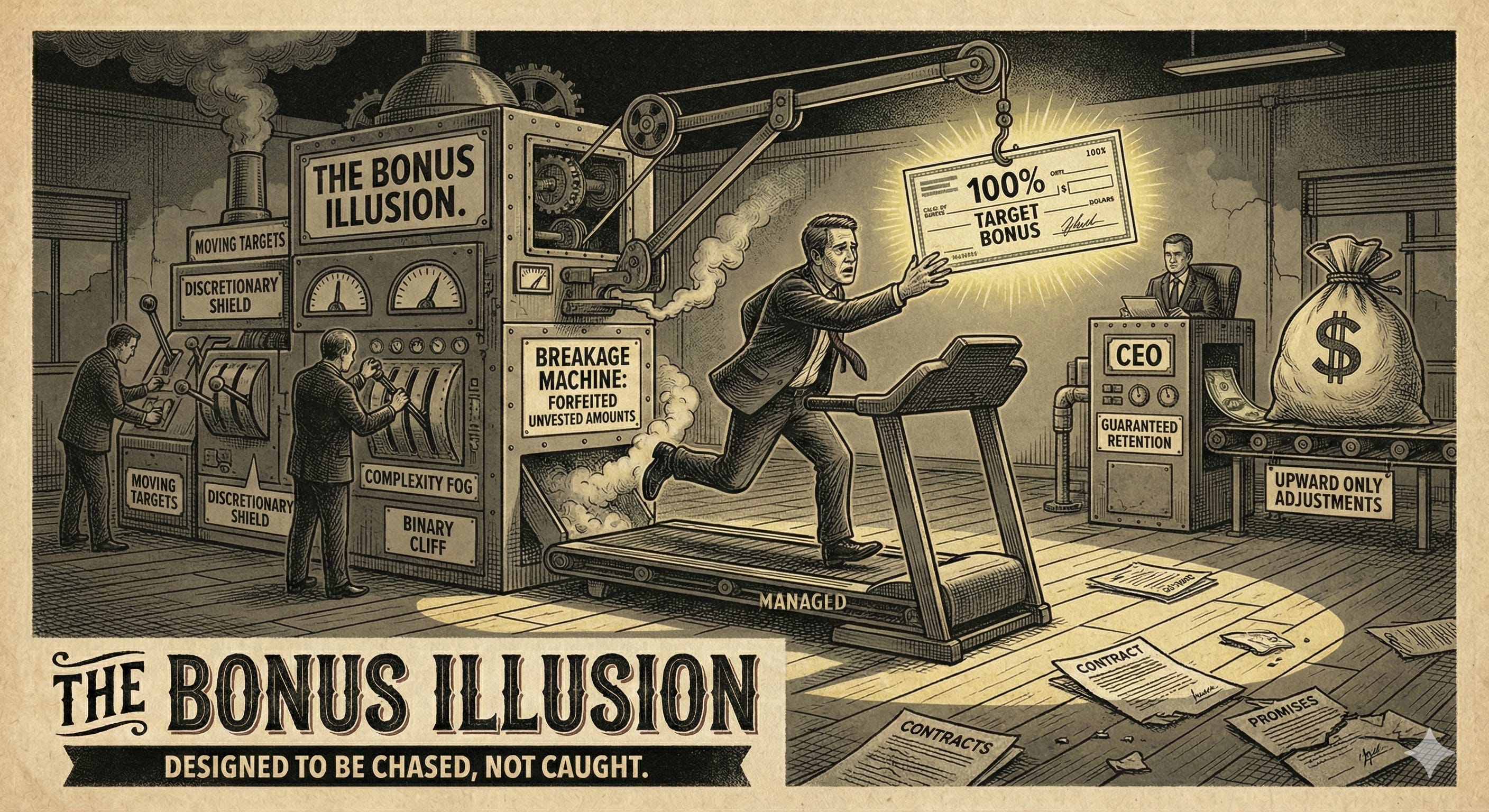
The Bonus as Financial Instrument: Why Your “Target” Was Never Meant to Be Paid
The Pattern Everyone Recognizes But Few Examine
Every fiscal year, the ritual repeats with predictable precision. Employees meet or exceed their performance targets. Managers deliver positive reviews, occasionally glowing ones. The organization’s financial results appear solid, sometimes exceptional. And then, with carefully constructed regret, the bonus arrives diminished—not eliminated entirely, not reduced to an insulting figure, but calibrated to a figure just below what was promised.
Not zero. Not outrageous. Just less.
This outcome occurs with such frequency across industries, company sizes, and economic conditions that it has ceased to register as anomalous. Yet this consistency itself demands examination. When a pattern manifests this reliably, it’s not a series of unfortunate coincidences or isolated failures of execution. It’s a feature of the system, operating exactly as designed.
The question employees ask—”Why is there always something that prevents full payout?”—contains its own answer. There is always something because the architecture of modern variable compensation requires there to be something. The bonus structure isn’t a reward system that occasionally malfunctions. It’s a financial engineering mechanism that functions optimally when full payment remains perpetually just out of reach.
The Architectural Shift: From Transparency to Opacity
To understand why bonuses systematically underpay, it’s necessary to examine how variable compensation evolved from simple profit-sharing to complex multi-factor equations that render full attainment mathematically improbable.
The Historical Model: Profit-Sharing’s Binary Clarity
Historically, variable compensation operated through straightforward profit-sharing mechanisms. If the corporation generated profit, a predetermined percentage was distributed to the workforce. This model possessed a virtue that modern compensation has systematically abandoned: transparency. The metric was singular (profit), the calculation was linear, and the relationship between company performance and employee payout was direct and verifiable.
Employees could track the company’s financial health through publicly available information. They could calculate, with reasonable accuracy, what their share would be before the formal announcement. The system was fundamentally binary: profit or no profit, payout or no payout.
The Contemporary Model: Multi-Factor Complexity as Structural Barrier
The modern bonus has mutated into something far more sophisticated and far less transparent. Contemporary management incentive plans are no longer tied to a single metric but operate as composite calculations involving weighted variables across multiple dimensions. A typical structure might allocate:
50% to Corporate Financials: Further divided between Revenue, EBITDA, and Free Cash Flow
30% to Business Unit Performance: Operational metrics specific to the employee’s division
20% to Individual/Strategic Goals: Subjective assessments of leadership, ESG contributions, or project completion
This fragmentation creates what can be termed the Compound Probability Problem. When bonus payment depends on achieving targets across multiple independent categories—individual performance, business unit results, and corporate financials—the likelihood of achieving all three simultaneously becomes substantially lower than the probability of succeeding at any single one.
The employee controls perhaps one-fifth of the total equation through individual performance, yet the failure of any component—particularly corporate EBITDA targets they cannot influence—can reduce the total payout disproportionately, often to zero through mechanisms called “funding triggers.” You can perform exceptionally on the dimensions you control while still receiving minimal or no bonus because categories outside your influence failed to meet threshold requirements.
The Linguistic Trap: Target vs. Maximum vs. Promise
A critical source of the expectation gap lies in the divergent definitions of “Target” between the recruitment phase and the administration phase. During hiring negotiations, “Target Bonus” is presented as part of total compensation, implying it represents the expected value or mean outcome. Recruiters frame it as: “Your base is $150,000, and with a 20% bonus, your total package is $180,000.”
Within Compensation Committees and Finance departments, however, “Target” carries a distinct technical definition. It represents the payout for achieving budgeted performance. Crucially, “Budget” in high-performance organizations is often set at a stretch level—a goal requiring extraordinary effort and favorable market conditions to achieve. Consequently, “Target” does not mean “Average” or “Expected.” It means “Excellent Performance Under Ideal Conditions.”
The “Maximum” payout (often 150% or 200% of Target) serves as psychological bait, suggesting unlimited upside potential. However, the distribution of actual payouts rarely forms a normal bell curve centered on Target. Instead, it typically skews left, with high frequency of zero or partial payouts due to circuit breakers, and a long tail of rare maximum payouts used primarily for marketing purposes.
This dissonance between the employee’s understanding of Target (the default expectation) and the company’s definition (the aspirational ceiling) represents the first structural barrier to full payment.
The Financial Gatekeepers: How Metrics Are Engineered to Fail
If architectural complexity establishes the foundation for underpayment, the financial metrics themselves function as the operational gatekeepers. The “something” that companies perpetually cite as preventing full payout typically manifests as failure to meet a specific, often manipulated, financial threshold.
The EBITDA Trap: The Malleability of “Adjusted” Metrics
Earnings Before Interest, Taxes, Depreciation, and Amortization (EBITDA) has become the dominant metric in incentive compensation plans. Its prevalence stems from its focus on operational performance, theoretically stripping away the noise of tax strategy and financing decisions. However, EBITDA is a Non-GAAP measure, meaning it lacks standardized, legally mandated definition. This creates the opportunity—and the widespread practice—of “Adjusted EBITDA.”
The power to “adjust” allows the company to function as arbiter of its own success. These adjustments are ostensibly designed to remove “extraordinary” or “one-time” events to reveal the true operational health of the business. In practice, they create a systematic asymmetry:
What Gets Adjusted Out (Protecting Executive Bonuses):
Restructuring costs
Legal settlements
Impairment charges
Acquisition-related expenses
“Strategic investments”
What Doesn’t Get Adjusted (Exposing Worker Bonuses):
Supply chain disruptions
Inflation impacts
Customer payment delays
Operational inefficiencies
Competitive pressures
When a company announces it “missed the EBITDA number,” it’s typically referring to this Adjusted figure, calculated using a specific set of inclusions and exclusions decided by the Board, often retroactively or at quarter-end. The asymmetry is neither accidental nor hidden—it’s documented in proxy statements. Executive compensation gets insulated from “non-operational” costs while broad-based employee bonuses remain exposed to “operational” headwinds.
The Funding Trigger: The Binary Cliff
Most bonus plans operate on a “Funding Trigger” or “Threshold” concept—a minimum performance level, typically in the high eighties to low nineties percent of Target, that must be achieved before any bonus pool receives funding.
The mechanism functions as a binary cliff: if the Funding Trigger is set at ninety percent of EBITDA and the company achieves just slightly less, the funding for that component often drops to zero. Not a proportional reduction—complete elimination.
Finance departments defend this structure by arguing that below the threshold, the company hasn’t generated sufficient surplus capital to afford bonus expense. The bonus is conceptualized as a distribution of excess value, not compensation for labor already performed.
To the employee, the difference between just below and just above the threshold is operationally negligible—it represents perhaps a single large deal closing in the final week of the fiscal year, or a customer payment delayed until January. Yet the payout difference is absolute: everything versus nothing. This binary structure is a primary reason employees perceive the system as rigged. They may have delivered substantial value (coming very close to a stretch goal represents significant achievement), but the circuit breaker negates all reward.
The Sandbagging and Ratcheting War: The Penalty for Success
The process of setting performance targets operates as a negotiation—often a concealed war—between Finance (represented by the CFO) and Operations (Business Units, Sales).
Sandbagging: Operational managers, understanding market volatility and the career consequences of missing targets, attempt to negotiate lower goals to maximize payout probability. They argue for conservative estimates based on worst-case scenarios.
The Ratchet Effect: Finance and the Board, aware of the incentive to sandbag, counter by systematically raising goals. They examine the previous year’s actuals and apply a growth factor: last year’s achievement plus a substantial increment becomes this year’s target.
The Penalty for Success: If a team works exceptionally in Year 1 and exceeds target substantially, the Ratchet ensures Year 2’s target is set at that elevated level. This creates a system where sustained full bonus attainment would require exponential growth in effort and results. Eventually, the target becomes mathematically unreachable without extraordinary market conditions, leading to a “reset” year where bonuses are necessarily missed.
The employee perception—”the better we perform, the harder they make it to get paid”—is not paranoia. It’s accurate observation of how the Ratchet Effect operates.
The Legal Architecture: Discretion as Shield
Perhaps the most formidable barrier to full bonus realization is the legal distinction between “discretionary” and “non-discretionary” compensation. This classification is the primary mechanism companies use to legally withhold promised funds and represents the clearest evidence of deliberate structural design.
The “Discretionary” Label: A Legal Firewall
Under the Fair Labor Standards Act (FLSA) in the United States, and parallel labor laws globally, bonuses are bifurcated into two categories:
Non-Discretionary Bonuses: Payments promised in advance based on specific criteria (e.g., “Achieve 100% of quota, receive $5,000”). Legally, these are classified as wages.
Discretionary Bonuses: Payments where the employer retains sole authority to determine both the fact of payment and the amount, up until the moment of payment. These are legally classified as gifts or gratuities, not wages.
The economic incentive for companies to classify bonuses as discretionary is substantial. If a bonus is non-discretionary, the FLSA requires that the bonus amount be retroactively incorporated into the employee’s base pay for the calculation period, and overtime rates must be recalculated accordingly.
Example: If an hourly employee earns a substantial non-discretionary bonus, the employer must recalculate all overtime hours worked during that bonus period and pay additional amounts on the overtime differential. This is administratively complex and financially expensive.
The Strategic Response: To avoid this liability, employment contracts are drafted by legal counsel to include explicit discretionary language. A standard clause reads: “The Company reserves absolute authority to interpret, modify, suspend, or terminate the Plan at any time. Participation in the Plan does not constitute a contractual entitlement to compensation.”
The Legal Implication: This language means that even if an employee achieves every metric on their scorecard, the company can legally decide to pay $0. The “Target” becomes legally unenforceable. Courts have generally upheld that if plan documents explicitly state the bonus is discretionary, the employee has no breach-of-contract claim when the company exercises that discretion to withhold payment, even if the justification is “macroeconomic caution” or “strategic realignment.”
The Active Employment Clause: The Golden Handcuff
A pervasive structural mechanism for bonus forfeiture is the “Active Employment” or “Retention” requirement. Most bonus plans stipulate that employees must be “employed in good standing on the date of payout” to receive the bonus.
The Timing Gap: Fiscal years typically end December 31st. However, bonuses are not paid until March or April, after external auditors certify financial results.
The Churn Profit: This creates a three-to-four-month dead zone. An employee who works the entire fiscal year (January 1–December 31), achieves all targets, and generates measurable value, but resigns February 15th, receives $0. The company retains the accrued bonus.
Strategic Implications: This structure functions as a retention mechanism, forcing employees to remain through Q1. It also allows companies to recover the bonus accruals of any employee who departs during post-year churn. In industries with high turnover (technology, consulting, finance), this unspent bonus pool represents significant retained earnings.
Opportunistic Termination: The Timing Weapon
In more contentious scenarios, employees allege “opportunistic termination”—being terminated “for cause” or laid off weeks before bonus payout dates.
If an employee is terminated for cause (misconduct, performance deficiency), they forfeit the bonus entirely. If laid off without cause, plan provisions vary; some offer prorated payouts, many do not.
While widely perceived as bad faith, proving that termination was specifically motivated by desire to avoid bonus payment is legally difficult. However, in jurisdictions like California, the “prevention of performance” doctrine occasionally allows employees to recover these wages if they can demonstrate the employer acted in bad faith to prevent bonus vesting.
The Recruiting Deception: Inflating Perceived Value Without Long-Term Cost
While accounting manipulations manage the reporting of costs and legal structures manage enforceability, the strategic structuring of compensation packages manages the actual long-term cost of labor. Bonuses are increasingly deployed as recruiting tools to inflate perceived total compensation while keeping fixed obligations (base salary) suppressed.
Sign-On Bonuses vs. Base Salary: The Compounding Differential
Recruiters routinely deploy substantial sign-on bonuses to bridge the gap between a candidate’s salary expectations and the company’s salary bands. While candidates perceive $20,000 cash upfront as equivalent to—or superior to—a higher base salary, the mathematical reality heavily favors the employer due to the compounding nature of base compensation.
Base salary increases compound annually; one-time bonuses do not. A substantial increase in base salary pays out every year of employment and serves as the foundation for all future percentage-based merit increases, retirement matching contributions, and benefits calculations. By substituting a one-time payment for a permanent salary adjustment, the employer realizes massive long-term savings.
Consider a typical scenario: An employee requests a base salary that’s ten thousand dollars higher than the company’s offer. Instead of increasing the base, the company offers that amount as a sign-on bonus. The candidate sees equivalent first-year compensation. The company sees dramatically different ten-year cost.
Over a decade, assuming standard annual merit increases, the difference compounds substantially. The employee who accepted the sign-on bonus instead of the higher base salary will have earned over one hundred thousand dollars less in total compensation—essentially forfeiting an entire year’s salary over the course of employment. The sign-on bonus tactic functions as a cost-containment mechanism that presents as generosity.
Furthermore, if the employee departs within the first year (or often two years), repayment clauses typically require return of the sign-on bonus, making even the Year 1 cost lower than salary would have been.
On-Target Earnings (OTE) Inflation: The Uncapped Commission Myth
In sales and performance-based roles, “On-Target Earnings” (OTE) serves as the primary recruiting metric. OTE combines Base Salary + Expected Commission/Bonus. Companies systematically inflate OTE figures to attract talent without committing to fixed costs, relying on “breakage”—failure to meet targets—to suppress actual payouts.
The Mechanism: Recruiters emphasize “uncapped commissions” to suggest unlimited earning potential. However, forensic analysis of sales compensation structures reveals that OTE is calculated based on quotas that only a small percentage of the sales force historically achieves.
The Mathematical Reality: Companies advertise attractive OTE figures, but set quotas such that historical attainment typically falls well short of target levels. This means the real expected cost to the company is substantially lower than the advertised compensation—often tens of thousands of dollars less per hire. This gap represents a recruiting premium that exists on paper but rarely materializes in actual expense.
Quota Manipulation: By adjusting quotas quarterly or annually, companies ensure that even high performers rarely exceed OTE significantly, effectively capping the “uncapped” plan through moving targets. If a sales representative exceeds quota dramatically in Q1, their Q2 quota is often raised proportionally (the “ratcheting” effect), ensuring they cannot maintain that earning pace.
Research indicates the majority of sales representatives report unclear or unrealistic OTE figures as a major source of dissatisfaction, confirming this is a systemic strategy to depress labor costs while maintaining recruitment appeal.
Total Rewards Statements: Marketing the Intangible
To distract candidates from lower base salaries, HR departments increasingly deploy “Total Rewards Statements” (TRS). These documents quantify non-monetary benefits—PTO value, training budgets, gym memberships, even employer tax contributions—to present an inflated “Total Compensation” figure.
A TRS might include “Employer FICA Contribution” (the tax the employer must pay by law) and “Health Insurance Premium” to boost the total package value by tens of thousands of dollars. While these represent real costs to the employer, presenting them as part of the employee’s “rewards” is a psychological framing tactic designed to make a standard market offer appear superior.
Valuation Inflation: Companies may assign dollar values to “Culture,” “Learning Management System Access,” or “Mentorship Programs”—items with zero marginal cost to the firm—to inflate TRS totals.
Effect: Studies demonstrate that presenting a TRS can increase perceived compensation value by fifteen to twenty-five percent without the company spending a single additional dollar on salary. This allows firms to compete for talent against higher-paying competitors by marketing their “hidden paycheck” rather than increasing visible compensation.
The Zero-Cost Illusion: Breakage, Forfeitures, and Executive Insulation
Sophisticated organizations structure bonuses—particularly Long-Term Incentives (LTIPs) and equity awards—such that a significant portion of promised compensation never actually vests. This phenomenon, termed “breakage,” allows companies to grant millions in face-value compensation while recognizing substantially lower expenses.
Long-Term Incentive Plan (LTIP) Breakage
LTIPs, typically structured as Restricted Stock Units (RSUs) or Performance Share Units (PSUs), are subject to multi-year vesting schedules (commonly 3-5 years). The “breakage rate” refers to the percentage of these awards forfeited due to employee turnover or failure to meet performance targets.
The Valuation Gap:
When a company grants substantial equity awards vesting over multiple years, the employee values the package at its face amount. However, the company statistically knows that a percentage of employees will depart before full vesting.
Accounting Treatment (ASC 718): Companies are required to estimate forfeitures at grant date. If a company estimates annual departures at common industry rates, it reduces recognized stock-based compensation expense accordingly.
Cost Reality: If an employee leaves halfway through a four-year vesting period, they forfeit half the award. The company received years of labor motivated by a substantial promise but paid only a fraction of the stated value. The unvested equity returns to the corporate pool, costing shareholders nothing in dilution.
Performance Share Units: For PSUs, breakage rates are substantially higher. These vest only if specific financial targets (Total Shareholder Return, EBITDA) are achieved. If the company underperforms, payouts can drop to zero. In 2024, despite record executive compensation, many companies cut middle-management bonuses citing “economic uncertainty,” utilizing the discretionary nature of these instruments to protect profit margins.
The 2024 Data: Divergent Outcomes by Organizational Level
Recent data from 2023 and 2024 illustrate the aggressive deployment of breakage mechanisms. Ford Motor Company announced it would eliminate stock bonuses for approximately half of its middle managers to “drive high-performance culture” and reduce costs, while maintaining executive incentive structures. Target reduced bonuses to below target levels for salaried employees in 2024, down from full target the prior year, citing sales headwinds.
In the technology sector, mass layoffs at Google and Meta in 2023/2024 resulted in forfeiture of unvested RSUs for thousands of employees. While severance was provided, the breakage on unvested equity represented massive recapture of potential compensation cost for these firms.
The Executive Divergence: Selective Austerity
The “zero-cost” nature of these mechanisms becomes most visible in the widening gap between executive and worker compensation. While companies deploy breakage and invoke “economic uncertainty” to reduce broad-based bonus pools, executive compensation—theoretically more “at risk”—has paradoxically surged.
2024 Executive Pay Trends: CEO compensation at S&P 500 companies increased substantially in 2024, driven largely by stock price recovery inflating LTIP values.
2024 Worker Bonus Decline: Conversely, end-of-year bonuses for the broader workforce declined across major industries. Technology sector bonuses dropped modestly, retail fell significantly, and transportation plummeted dramatically.
The Pattern:
Group2024 TrendJustificationExecutivesSubstantial increase”Market recovery,” “retention needs”Technology WorkersModest decline”Economic uncertainty”Retail WorkersSignificant decline”Sales headwinds”Transportation WorkersDramatic decline”Operational challenges”
This divergence confirms that while executive bonuses are treated as structural necessities (often insulated by target adjustments or stock buybacks that artificially boost EPS), worker bonuses are treated as truly variable operational costs to be minimized whenever macro narratives permit.
The Psychological Architecture: Why Employees Keep Believing
The structural and legal mechanisms described above would fail if employees simply rejected the bonus system entirely. The system persists because it successfully exploits specific psychological vulnerabilities that keep employees engaged despite consistent underpayment.
Intermittent Reinforcement: The Slot Machine Effect
Behavioral psychology has long understood that intermittent reinforcement—rewards delivered unpredictably—produces more sustained engagement than consistent reward schedules. A bonus that is:
Occasionally generous
Often moderately disappointing
Never entirely predictable
...generates more persistent effort than a stable, guaranteed payout would.
The employee doesn’t feel cheated enough to disengage entirely. They feel close enough to full payout that continued effort seems rational. The system doesn’t require employees to be satisfied—it requires them to be almost satisfied, perpetually.
The Near-Miss Phenomenon: Close Enough to Keep Trying
When a bonus pays out at most of the target amount but not quite all, it functions psychologically as a near-miss rather than a failure. The employee processes this as: “I almost made it.” This framing preserves hope and motivates renewed effort (”next year I’ll close that gap”) rather than triggering disengagement.
If bonuses consistently paid very low percentages or nothing, employees would correctly identify the system as fraudulent and disengage. If bonuses consistently paid full target, employees would come to expect that level and it would lose motivational power. The high-but-not-quite-full range is optimal for sustained engagement without full cost.
Retrospective Justification: Internalizing Structural Outcomes
After a partial payout, employees engage in a predictable cognitive maneuver: they reinterpret the past rather than questioning the structure. They ask themselves:
“Could I have communicated impact better?”
“Should I have aligned more closely with leadership priorities?”
“Did I miss an opportunity to exceed expectations?”
This retrospective justification transforms a collective structural problem into an individual performance assessment. The system remains unexamined because the disappointment is internalized as personal responsibility.
The Annual Reset Illusion: Deferring Pattern Recognition
Every bonus cycle is treated as a clean slate. New targets, new narratives, new optimism. What is systematically excluded from examination is the pattern across years:
Consistent underpayment relative to target
Repeated recalibration of metrics
Endless “exceptions” that somehow recur annually
The calendar resets, but the underlying structure does not. This annual amnesia prevents pattern recognition from crystallizing into collective understanding.
Hope as Cost-Effective Control
From an organizational perspective, hope represents an extraordinarily cost-effective control mechanism. It requires:
No contractual modifications
No transparency improvements
No redistribution of financial risk
Only reassurance
As long as employees believe improvement is imminent—that next year will be different if they just perform slightly better—the system avoids structural scrutiny. Critical examination is replaced by patience and renewed effort.
The Broader Economic Context: Stock Buybacks and Capital Allocation
A critical element frequently excluded from bonus discussions is the trade-off between employee compensation and shareholder returns, particularly through stock buyback programs.
Buybacks vs. Bonuses: The Opportunity Cost
Research from the Roosevelt Institute indicates U.S. corporations spent the majority of their profits on stock buybacks in the mid-2010s. To contextualize this allocation choice:
Home Depot spent enough on buybacks to have theoretically provided each employee a substantial annual raise
McDonald’s could have significantly increased worker compensation annually using buyback funds
The Mechanism: Stock buybacks reduce outstanding share count, artificially inflating Earnings Per Share (EPS). Since executive bonuses are frequently tied to EPS targets, buybacks directly increase executive compensation while utilizing cash that could have funded broad-based employee bonuses.
This represents a systematic transfer of capital from labor (potential bonuses) to shareholders and executives (whose compensation is tied to share price and EPS metrics).
“Economic Uncertainty” as Selective Lever
The narrative of economic uncertainty serves as a strategic lever applied selectively. In 2023 and 2024, despite many companies recording substantial profits, bonuses were reduced.
The Stated Justification: Companies cite “macro headwinds,” “geopolitical volatility,” or “prudent cash management” to justify cutting discretionary compensation.
The Operational Reality: Since bonuses are variable costs, eliminating them represents the fastest mechanism to preserve Free Cash Flow without the negative publicity of layoffs. It allows companies to accumulate cash reserves during uncertain periods while placing the entire burden of that uncertainty on the workforce rather than shareholders.
Case Studies: When the System Breaks Visibly
The abstract mechanisms of bonus reduction are vividly illustrated by high-profile cases where the gap between promise and payment became legally contested.
Dell Inc.: The $100 Million Cookie Jar
Dell paid a $100 million penalty to the SEC for accounting fraud related to bonus reserves used for earnings management. Between 2002 and 2006, Dell maintained reserves that allowed it to meet or beat analyst earnings estimates in every quarter.
The complexity involved undisclosed payments from Intel. Dell received exclusivity payments for using Intel chips but, rather than recognizing these as revenue immediately, effectively stashed them in various reserve accounts, including bonus reserves. When operational earnings fell short, Dell released these reserves to cover gaps.
The SEC determined that without these manipulations, Dell would have missed earnings consensus in nearly every quarter during that four-year period. This demonstrates how bonus reserves function alongside other “soft” liability accounts to create a portfolio of earnings management tools.
Computer Sciences Corporation: The Phantom Bonuses
In 2015, the SEC charged CSC with accounting fraud involving cookie jar reserves. Investigation revealed CSC had built excess reserves related to employee bonuses ($590,000 AUD) and corporate restructuring.
Crucially, the company never paid the bonuses and failed to document the supposed restructuring plan—a specific requirement under ASC 420 for recording termination reserves. When CSC needed to boost earnings in Q1 fiscal year 2009, it released these bonus accruals. The reversal allowed CSC to hit analyst earnings targets it otherwise would have missed.
Twitter/X: The Mass Severance Dispute
Following Elon Musk’s acquisition of Twitter (now X), thousands of employees were terminated. A central legal battle emerged over unpaid severance and bonuses totaling hundreds of millions of dollars.
Twitter’s plan documents allegedly promised specific severance and bonus payouts. After acquisition, the company refused payment, arguing plans were discretionary or employees were terminated “for cause”—a blanket justification applied to mass layoffs.
The resulting litigation and settlements illustrate the fragility of bonus promises. When a company decides to deploy the “discretionary” nature of compensation plans aggressively, employees are forced into litigation to pursue what they believed was contractually guaranteed.
Wells Fargo: The Expansion of Clawbacks
The Wells Fargo fake accounts scandal introduced aggressive deployment of clawback provisions—mechanisms allowing companies to recoup bonuses already paid if misconduct is discovered later.
Initially designed for fraud recovery, clawback policies are expanding to include broad “reputational harm” or “risk management failure” clauses. This creates retroactive uncertainty: an employee can receive their full bonus, spend it, and face repayment demands years later if the company determines a policy was violated.
This effectively transforms the “paid” bonus into a conditional loan subject to revocation based on criteria decided unilaterally by the employer.
Conclusion: The Structural Deliberation
The central question—”Is it deliberate?”—requires a qualified affirmative answer accompanied by important distinctions.
It is rarely the case that executives convene meetings to explicitly discuss “how to cheat employees out of bonuses.” Rather, the system is deliberately designed at multiple levels to prioritize capital preservation and shareholder returns over employee compensation certainty.
Financial Deliberation: The deployment of Adjusted EBITDA, funding triggers, and ratchet effects deliberately positions employees last in capital distribution hierarchies.
Legal Deliberation: The universal adoption of “discretionary” classification deliberately strips employees of contractual enforceability rights regarding bonus payments.
Psychological Deliberation: The use of near-miss payouts, stretch goals, and annual resets deliberately creates statistical improbability of sustained 100% attainment while maintaining engagement.
Architectural Deliberation: The shift from transparent profit-sharing to opaque multi-factor calculations deliberately reduces employees’ ability to assess, in real-time, whether they are on track for full payout.
The “Target Bonus” is most accurately understood not as a promise but as a maximum theoretical cap, protected by multiple overlapping mechanisms that ensure actual payouts systematically fall short. It functions as a recruiting tool and motivational device rather than a compensation commitment.
The reason there is “always something”—a missed metric, a macroeconomic event, a retroactive policy adjustment—is that the system provides an extensive menu of circuit breakers for corporations to deploy. In the casino of corporate compensation, the house has engineered the odds to ensure that while some individuals occasionally win maximum payouts, the aggregate cost never threatens the house’s financial position.
The bonus is not a reward system that occasionally malfunctions. It is a financial instrument operating exactly as designed: to extract sustained maximum effort from employees while minimizing and deferring the associated costs to the organization. The disappointment employees feel when bonuses arrive diminished is not a bug in the system—it is evidence the system is functioning precisely as intended.
References
Earnings Management and Cookie Jar Reserves
U.S. Securities and Exchange Commission. “SEC Charges Dell and Senior Executives with Disclosure and Accounting Fraud.” Press Release, July 22, 2010. Details Dell’s $100 million penalty for accounting fraud involving reserve manipulation.
U.S. Securities and Exchange Commission. “SEC Charges Computer Sciences Corporation with Accounting Fraud.” Press Release, August 18, 2015. Documentation of CSC’s fraudulent bonus reserve reversals.
Bonus Structure and Legal Classification
U.S. Department of Labor. Fair Labor Standards Act (FLSA) guidance on discretionary vs. non-discretionary bonuses and overtime calculation requirements.
Internal Revenue Code Section 404 and Treasury Regulation 1.404(b)-1T regarding the 2.5-month rule for bonus deductibility.
2024 Compensation Trends
Gusto. “2024 Bonus Season Analysis.” Data on year-over-year decline in bonus frequency and amounts across industries.
Deloitte. “2024 Global Human Capital Trends.” Analysis of worker bonus reductions amid economic uncertainty.
Equilar / Wall Street Journal. “2024 CEO Pay Analysis.” Documentation of 7-14% increase in S&P 500 CEO compensation.
Recruiting Tactics and Total Rewards
PayScale. “Total Rewards Statements: Impact on Perceived Compensation Value.” Research demonstrating 15-25% increase in perceived value through TRS presentation.
Sales compensation industry analyses on OTE inflation and quota manipulation practices.
Stock-Based Compensation and Breakage
Financial Accounting Standards Board. Accounting Standards Codification (ASC) 718: “Compensation—Stock Compensation.” Guidelines on forfeiture estimation and expense recognition.
Reuters and Bloomberg reporting on Ford, Target, Google, and Meta bonus reductions and unvested equity forfeitures in 2023-2024.
Stock Buybacks and Capital Allocation
Roosevelt Institute. “Corporate Spending on Stock Buybacks and Worker Compensation.” Analysis of profit allocation between buybacks and employee compensation.