
The Corporate Mental Health Mirage
What Really Happens When You Tell the Truth

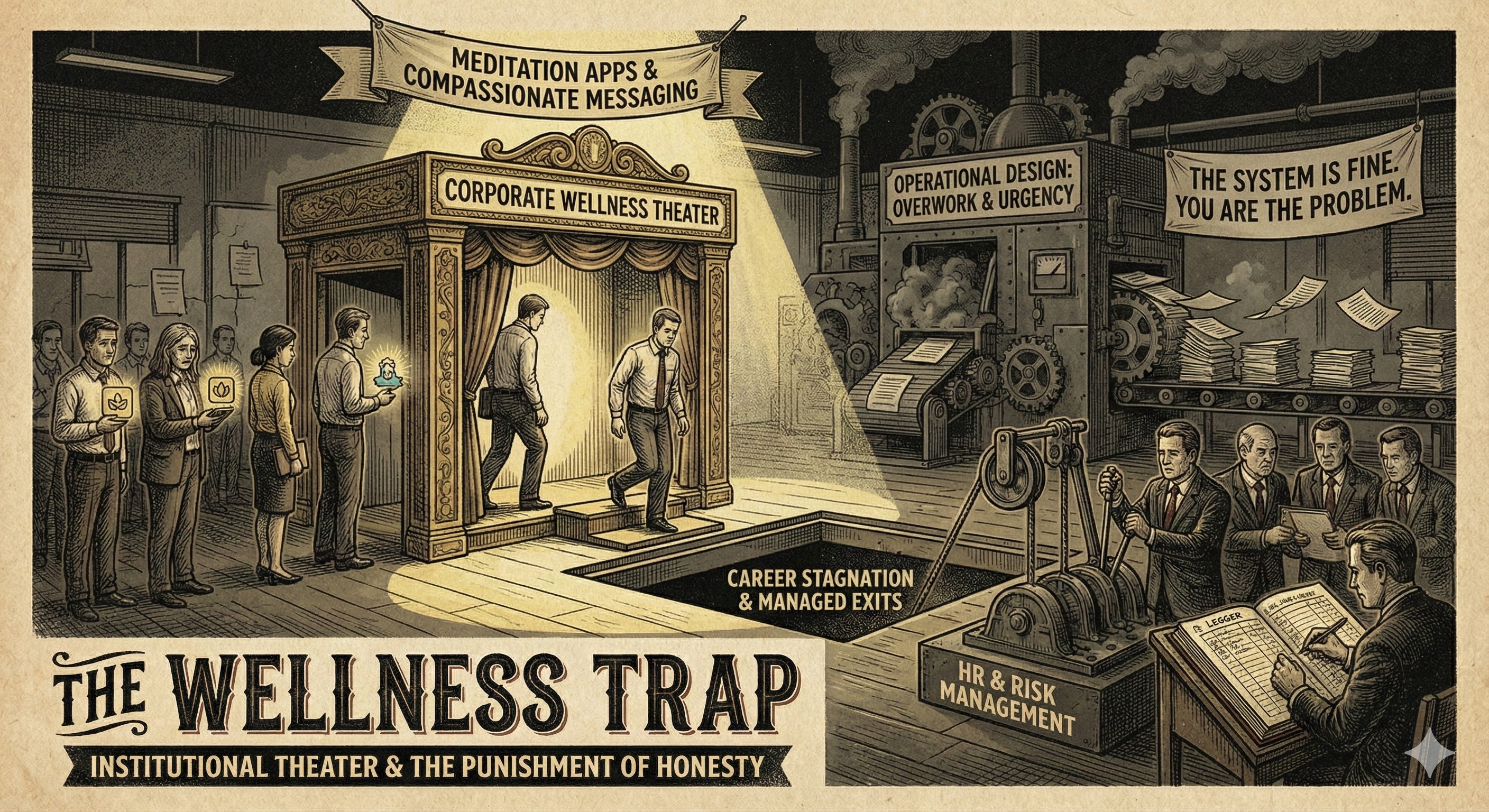
The Facade of Concern
Corporate culture has mastered the aesthetics of empathy. Wellness posters line the corridors. HR departments launch mental health initiatives with the gravity of humanitarian missions. CEOs share carefully curated stories about their own burnout, framed to suggest vulnerability without admitting institutional liability. The messaging is comprehensive, the investment substantial, the language impeccable.
Yet employees who work within these systems recognize the disconnect between the stated values and the operational reality.
In today’s corporate landscape, mental health awareness has become both moral imperative and marketing asset. “Bring your whole self to work,” the posters proclaim, while the unspoken corollary remains universally understood: But not that part. Never that part.
What becomes clear through observation is this: disclosing a mental health struggle inside most corporations isn’t treated as an act of courage. It functions as an act of professional risk that unfolds gradually while the institution maintains plausible deniability about the consequences.
What Actually Causes the Deterioration
Before examining what happens when employees acknowledge mental health struggles, it’s necessary to examine what creates them. The conversation about workplace mental health typically centers on individual resilience while carefully avoiding the structural conditions that generate psychological damage.
The Architecture of Exhaustion
Modern corporations have engineered work environments that produce predictable patterns of psychological deterioration:
Continuous partial attention as operating system. Employees are expected to maintain simultaneous engagement across multiple platforms—email, Slack, Teams, project management tools—while also attending meetings and producing substantive work. The human brain processes information sequentially, not simultaneously. What organizations label “multitasking” functions as rapid context-switching, which research demonstrates produces measurable cognitive degradation and stress hormone elevation. Yet this fragmented attention state is treated as baseline competence rather than a neurological assault with documented consequences.
The normalization of unsustainable hours. Fifty-hour weeks have become the floor, not the ceiling. “Crunch time” has metastasized from exception to permanent condition. The implicit employment contract has shifted: compensation is no longer for a defined number of hours but for whatever duration proves necessary to meet objectives that are, by design, calibrated slightly beyond what’s achievable within reasonable time constraints. This isn’t accidental miscalculation. It’s how organizations extract maximum output while maintaining institutional deniability about the human cost.
Artificial urgency as management technique. Every request arrives coded as critical. Every deadline is presented as make-or-break. The perpetual crisis state maintains employees in a sustained low-grade fight-or-flight response, which measurably suppresses immune function, disrupts circadian rhythms, and degrades executive function. Managers who’ve internalized this approach no longer recognize it as a technique—they perceive it as accountability. The system selects for this particular form of blindness.
Passive-aggressive communication masked as professionalism. Direct feedback is rare; indirect punishment is constant. Disappointment communicated through tone rather than content. Expectations revised retroactively through implication rather than explicit instruction. Meetings that could provide clarity deliberately kept ambiguous. The employee is maintained in a state of perpetual uncertainty about their standing—a dynamic borrowed from psychological manipulation, deployed as leadership methodology. The ambiguity serves a function: it keeps people anxious and therefore compliant.
Meeting proliferation as displacement activity. Organizations schedule so many meetings about work that actual work becomes something done outside work hours. The meeting serves as evidence of engagement while preventing accomplishment. Everyone involved understands this dynamic, yet the pattern persists because it distributes responsibility while concentrating the appearance of productivity.
These aren’t unfortunate byproducts of dynamic business environments. These are design choices—ways of organizing human effort that prioritize short-term extraction over long-term sustainability. The mental health crisis in corporate environments is the predictable output of these specific inputs.
The Price of Honesty
The modern corporate world has perfected a peculiar form of doublespeak: it celebrates authenticity while punishing honesty. It demands vulnerability while recording every moment of weakness for future reference. Employees learn this contradiction early—not through explicit prohibition, but through watching what happens to those who break character first.
For those who speak truthfully about depression, anxiety, or burnout, the institution responds with a sequence that unfolds with remarkable consistency:
