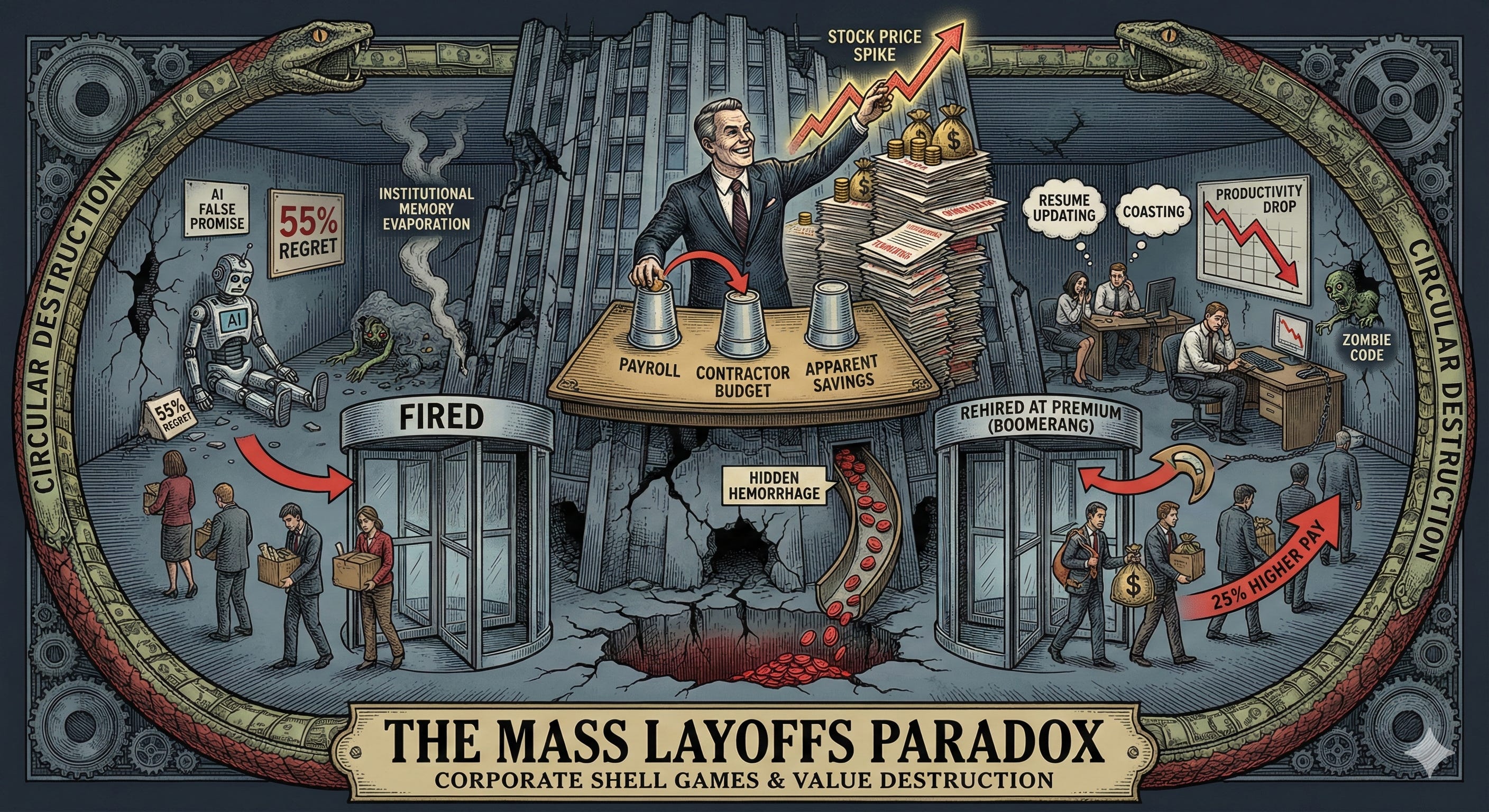
The Mass Layoffs Paradox
Why the Corporate Shell Game of Firing and Rehiring Destroys Value
The modern corporate landscape has perfected an economic absurdity so profound it defies rational explanation: companies systematically fire employees to “cut costs,” only to rehire identical or similar positions months later at dramatically higher expense. This is not occasional miscalculation. This is systematic value destruction wrapped in the language of efficiency, a ritual that transfers wealth to executives while hollowing out the productive capacity of the firm itself.
As of February 2026, over 39,000 tech workers have been laid off in just the first six weeks of the year. This continues a brutal pattern: 1.17 million job cuts announced in 2025, with nearly 245,000 eliminated from tech companies alone. Meta cut 1,500 from Reality Labs. Amazon eliminated 30,000 positions across two rounds of cuts. Microsoft, Google, Salesforce, Intel, and hundreds of others joined the synchronized purge, each citing “strategic restructuring,” “AI-driven efficiency,” or the perennial favorite, “macroeconomic headwinds.”
The stated logic is immaculate: reduce operating expenses, improve margins, signal discipline to shareholders, and position for sustainable growth. Leadership presents these decisions as painful but necessary, consultants nod approvingly, and stock prices spike on command. But the empirical reality tells a starkly different story. According to ADP Research, 35% of all new hires in March 2025 were “boomerang employees”—people returning to former employers. In the information sector, nearly two-thirds of new hires were returnees, double the rate from a year earlier. Google, after conducting its largest layoff in history in 2023, rehired former employees for 20% of its AI engineering positions in 2025.
This isn’t course correction. This is an institutionalized pattern of wealth destruction disguised as prudent management. The severance packages, unemployment insurance increases, productivity gaps, recruitment fees, and rehiring premiums often exceed—by orders of magnitude—any savings generated by the original terminations. Research shows that while retained employees receive nominal 4% annual raises, boomerang hires command pay increases averaging 25%. The employee earning $100,000 who receives a $20,000 severance and returns six months later at $125,000 represents not a cost savings but a catastrophic failure of workforce planning that destroyed tens of thousands of dollars in shareholder value.
Yet the cycle continues, accelerating rather than diminishing, because the incentives driving these decisions have nothing to do with operational efficiency and everything to do with executive compensation structures, mimetic corporate behavior, and accounting gimmicks that prioritize short-term stock price movements over long-term enterprise value.
The Strategic Logic of Economic Irrationality
Executive Compensation and the Wall Street Effect
The paradox resolves when you understand what corporations actually optimize for: not long-term value creation, but immediate stock price appreciation that triggers executive bonuses and option vesting. When a company announces layoffs, the market responds with mechanical predictability—the stock price rises. Investors interpret workforce reduction as proof of fiscal discipline, evidence of management’s commitment to margin expansion, and validation that leadership is willing to make “tough decisions.” This Pavlovian response creates a perverse incentive structure where executives whose compensation packages are dominated by stock options and grants can generate immediate personal wealth by cutting payroll.
This is not theoretical conjecture. Empirical research confirms the causal link: firms that announce layoffs often pay their CEOs significantly more in subsequent years, rewarding them for workforce reduction even as long-term financial performance deteriorates. The structure of modern executive pay—dominated by equity incentives with short vesting periods—encourages volatility. Layoffs that spike the stock price allow executives to exercise options at a premium and cash out before the long-term operational damage becomes apparent. What appears on the surface as “pay for performance” has mutated into “pay for payroll reduction,” where human capital is treated as a liability to be liquidated rather than an asset to be leveraged.
Studies tracking companies two years after layoff-induced stock bumps reveal a stark pattern: the majority trade below market averages and below industry peers. The immediate “pop” reverses as operational deficiencies compound, innovation stagnates, and competitive position erodes. But by then, the architects of the restructuring have already collected their bonuses and moved on, leaving shareholders to absorb the long-term destruction while executives accumulate wealth from decisions that destroyed enterprise value.
Mimetic Isomorphism: The Contagion of Copycat Cuts
A significant portion of corporate layoffs cannot be explained by financial distress, operational necessity, or legitimate restructuring needs. They are manifestations of “mimetic isomorphism”—organizations modeling themselves after peers in uncertain environments to gain legitimacy. Stanford professor Jeffrey Pfeffer characterizes recent tech sector layoffs as fundamentally driven by “social contagion”: when one major player initiates cuts, others follow not because their specific circumstances demand it, but to avoid appearing bloated or undisciplined in comparison.
This copycat behavior spreads through corporate networks like an epidemic. When Meta announces 10,000 layoffs, Google’s board demands explanations for why they haven’t undertaken similar “optimization.” When Microsoft cuts 9,000, Amazon faces pressure to justify its headcount. The synchronous nature of these reductions across tech giants—occurring within weeks of each other despite vastly different financial positions and growth trajectories—reveals coordination through imitation rather than independent operational assessment.
The logic becomes circular and self-reinforcing: we are firing because everyone else is firing, and everyone else is firing because we are firing. For executives, this mimetic behavior serves a crucial psychological function—it reduces the anxiety of decision-making under uncertainty. If a CEO lays off thousands and the company fails, they can blame the “macroeconomic climate” that forced the entire industry to contract. If they retain staff and struggle, they risk being labeled individually incompetent for failing to follow industry best practices. Layoffs become a defensive mechanism for executive job security, irrespective of the firm’s actual labor needs.
The narrative of “over-hiring during the pandemic” provides convenient justification, but the subsequent cuts often slice far deeper than mere correction. Companies that doubled headcount between 2019 and 2022 have eliminated not just pandemic hires but core engineering, product development, and institutional knowledge. The “right-sizing” rhetoric masks layoffs that fundamentally impair operational capability.
The AI Future-Faking: Laying Off for Promises, Not Performance
The latest iteration of this destructive pattern involves “AI efficiency” as justification for workforce reduction. Companies claim that artificial intelligence and automation will enable them to do more with less, justifying cuts in customer service, engineering, and management. The critical flaw: the technology is often not ready to replace the displaced workers, creating operational gaps that force emergency rehiring.
Salesforce provides a perfect case study. In August 2025, CEO Marc Benioff boldly proclaimed that AI would not lead to “some huge mass layoff of white collar workers,” insisting everyone needed to “let it go.” Three weeks later, news broke that Salesforce had cut 4,000 customer support positions—nearly half its support team—citing AI agents as the replacement. By September, Benioff confirmed on a podcast that support headcount dropped from 9,000 to 5,000 because “I need less heads.” The company claimed AI agents handled 1.5 million conversations with customer satisfaction scores matching human agents.
But the reality proved more complex. By February 2026, Salesforce was conducting another round of layoffs affecting under 1,000 employees—ironically including teams working on Agentforce, the very AI product justifying the original cuts. Industry observers noted the irony: employees building AI tools to automate work were themselves automated. Critics pointed out that Salesforce didn’t “reimagine support with AI”—they cut nearly half their support team and used AI as the excuse, a distinction with profound implications for service quality and operational sustainability.
The pattern extends industry-wide. Forrester Research’s “Predictions 2026” analysis found that 55% of employers regret laying off workers for AI, and predicts half of AI-attributed layoffs will be quietly rehired—often offshore or at significantly lower wages. Visier’s analysis of 2.4 million employees at 142 companies found that 5.3% of laid-off employees end up rehired by their former employer, with rates ticking upward amid AI implementation. This reveals the fundamental miscalculation: companies are laying off workers for AI capabilities that don’t exist yet, betting on future promises rather than proven technology.
When those bets fail, companies face a choice: admit the mistake and rehire at previous salaries, or quietly fill gaps with lower-cost offshore labor. Most choose the latter, transforming “AI efficiency” into wage arbitrage disguised as technological progress. AI accounts for just 4.5% of actual 2025 layoffs according to Oxford Economics, yet 59% of hiring managers admit emphasizing AI in layoff announcements because it “plays better with stakeholders” than admitting budget pressures. The AI narrative provides sleek cover for cost-cutting that would otherwise appear as simple financial fragility.
The Financial Illusion: How Layoffs Destroy Rather Than Create Value
The Boomerang Effect: Rehiring at Premium Cost
The most glaring economic failure of the layoff cycle manifests in boomerang rehiring—companies bringing back the same individuals or their functional equivalents shortly after termination, often at substantially higher compensation. While boomerang employees comprise only 2% of the total workforce, they consistently account for nearly one-third of new hires across industries. The financial implications are devastating.
Research confirms that boomerang hires command average pay increases of 25% compared to the 4% raises received by employees who stayed. This dynamic obliterates any savings from the original layoff. The company pays severance (typically 4-24 weeks of salary plus benefits continuation), absorbs productivity gaps during the vacancy, incurs recruitment costs (15-25% of annual salary in agency fees), and then reacquires the same asset at 25% higher cost. For an employee earning $100,000 annually, the total destruction looks like this:
Severance payment: $20,000
Unemployment insurance increase: $6,650 average
Recruitment fees for replacement: $25,000
Productivity loss during 6-month vacancy: $25,000 (50% of half-year salary)
Rehire cost at 25% premium: $125,000 annually
Total cost of the cycle: $76,650 plus ongoing $25,000 annual premium
This isn’t a one-time error. It’s systematic institutional practice affecting hundreds of thousands of positions annually. Google’s 20% boomerang rate for AI engineers reveals the scale: after cutting 12,000 in 2023, the company is re-acquiring talent it terminated, likely at significant premium given the competitive AI talent market. The company that claimed it needed to cut costs is now paying more for labor than before the cuts, having destroyed shareholder value through severance, lost productivity, and recruitment premiums.
The Contractor Arbitrage: The Shell Game of Labor Costs
When hiring freezes prevent direct rehiring of full-time employees, companies turn to contractors and consultants, creating an accounting arbitrage that appears efficient in isolation but is catastrophically expensive in aggregate. Managers desperate to maintain operations hire laid-off staff back as independent contractors or through consulting firms. The hourly rate for contractors is typically 1.5x to 2x comparable FTE wages to account for lack of benefits, taxes, and agency margins.
A laid-off engineer earning $60/hour as an employee returns as a consultant billing $120/hour. Companies argue they “save” on benefits (health insurance, retirement matching) and payroll taxes (Social Security, Medicare), but these savings rarely offset the 50-100% markup. More critically, this practice is driven by budgetary optics rather than genuine efficiency. FTE salaries come from “Headcount” budgets that are scrutinized and capped by CFOs during restructuring. Contractor fees come from “Program,” “Vendor,” or “Project” budgets that remain fluid and less visible.
This accounting treatment allows firms to manipulate financial ratios by moving labor costs off the payroll ledger into general operating expenses. The company reports reduced headcount to Wall Street—improving metrics like “Revenue per Employee”—while actual cash outflow for labor increases. It is financial obfuscation that trades long-term profitability for short-term optical compliance with headcount targets. The practice is both economically destructive and legally precarious: the IRS and Department of Labor actively pursue misclassification cases where “contractors” perform the same work under the same supervision as when employed. Nike faces potential fines exceeding $530 million for misclassification. FedEx has paid hundreds of millions in settlements.
The Hidden Transaction Costs: Friction in the Machine
The friction costs of workforce churning are substantial and systematically underestimated in restructuring plans:
Severance and Separation: Immediate cash outflows for salary continuation, COBRA subsidies, accrued vacation payouts. Meta alone paid $975 million in severance for 11,000 employees in 2022-2023. Average cost: 4-24 weeks of payroll per employee plus benefits continuation.
Recruitment and Onboarding: Agency fees (15-25% of annual salary), advertising costs, background checks, and the internal time cost of interviewing. Rehiring requires repeating this entire cycle. Average cost: 0.5x to 2x annual salary per replacement.
Unemployment Insurance: Layoffs trigger increases in state unemployment insurance tax rates based on claims history. This is a lagging cost that persists for years, affecting payroll taxes on all employees. Average claim cost: $6,650 per employee.
Productivity Loss: Vacancy periods create immediate output gaps. New hires typically take 6-12 months to reach full productivity, even for boomerang employees returning to familiar environments. Average cost: 50-75% of annual salary in lost output during the first year.
Legal and Compliance Risk: Wrongful termination suits, discrimination claims, and compliance fines. Misclassification of rehired “contractors” brings IRS and DOL scrutiny. Settlements routinely reach millions. The legal exposure compounds with each cycle of layoffs and rehiring.
Corporate Amnesia: The Destruction of Institutional Memory
Perhaps the most devastating yet least quantifiable consequence of cyclical layoffs is “corporate amnesia”—the collective forgetting of how an organization actually functions. Organizations are not merely collections of assets and contracts; they are networks of human relationships and accumulated knowledge. When these networks are severed, the organization loses its ability to learn, adapt, and operate safely.
Tacit vs. Explicit Knowledge: What Gets Lost
Organizational memory exists in two distinct forms. Explicit knowledge is codified in manuals, databases, wikis, and standard operating procedures. It is the “hard” data executives believe runs the company. While valuable, it is static, often outdated, and frequently divorced from operational reality.
Tacit knowledge is the experiential, intuitive wisdom held by individuals. It includes knowing who to call when the documented process fails, how to navigate regulatory gray areas, why specific engineering solutions were discarded, and the accumulated pattern recognition that comes from years of experience. This is “clinical wisdom”—the ability to diagnose problems based on subtle signals, to anticipate failures before they manifest, to understand the second and third-order consequences of decisions.
Layoffs disproportionately destroy tacit knowledge because it cannot be downloaded, transferred, or preserved through documentation. When a senior engineer or veteran project manager is terminated, they take with them the living memory of the organization. This knowledge is cumulative, slow to diffuse, and impossible to capture in exit interviews. Its loss forces the organization to “re-learn” lessons already mastered, repeating expensive mistakes and reintroducing solved problems.
The Catastrophic Cost of Re-Learning
When institutional knowledge is lost, organizations devolve into crisis management mode—”managing with your hair on fire.” New teams repeat failed experiments because they lack historical context for why certain paths were abandoned. Bug counts increase as development teams inherit “zombie code”—legacy systems no one understands but everyone fears to modify. The original authors were terminated, and the remaining staff lacks the mental maps to maintain or update critical infrastructure.
Boeing’s trajectory provides the canonical cautionary tale. Following its merger with McDonnell Douglas, the company shifted from an engineering-centric culture (”where safety is king”) to a cost-centric one dominated by financial metrics. Mass layoffs of seasoned engineers and strategic moves toward outsourcing severed the link between design and manufacturing. “Bean counter” logic replaced engineering judgment. The decentralized safety culture was systematically dismantled.
The 737 MAX disasters were not random failures; they were predictable outcomes of decades of eroded institutional knowledge. Engineers who understood legacy systems were replaced by cheaper, often outsourced talent who lacked deep institutional context. The concept of “normalization of deviance”—where safety standards slowly erode because new employees don’t understand the “why” behind rules—became operational reality. Veteran engineers who could recognize subtle warning signs were gone, replaced by staff who lacked the intuitive pattern recognition that comes only with experience.
Boeing now scrambles to re-staff manufacturing and engineering roles, attempting to address quality failures created by its own cost-cutting. But the institutional knowledge gap created by decades of erosion cannot be filled simply by hiring new bodies. The “culture of safety” was an emergent property of a specific workforce, built over generations. Rebuilding it requires not just hiring engineers but reconstituting the social networks, mentorship relationships, and accumulated wisdom that made Boeing synonymous with aerospace excellence. This is a multi-year, multi-billion dollar endeavor with uncertain prospects for success.
Ghost Work and the AI Displacement Mirage
A modern iteration of the layoff-rehire paradox involves replacing human staff with “artificial intelligence,” discovering the AI is insufficient, and quietly rehiring humans—often in low-wage jurisdictions—to act as the “ghost in the machine.”
Amazon’s “Just Walk Out” technology exemplifies this pattern. Marketed as a triumph of computer vision and AI automation, reports in 2024 revealed the system relied heavily on over 1,000 workers in India manually reviewing video footage to verify transactions. The “automation” was largely a facade for labor arbitrage—replacing visible domestic employees with invisible offshore workers. This reveals a key paradox: the AI transition often requires more human labor, not less, but companies lay off local staff prematurely based on aspirational capabilities, forcing scrambling for offshore replacements to maintain the illusion of automation.
Klarna provides another high-profile case. The fintech company cut roughly 700 customer service jobs, claiming an AI chatbot developed with OpenAI could do the work of 700 humans. While initially touted as an efficiency breakthrough, the aggressive cuts reportedly led to degradation in complex query resolution and customer satisfaction. The CEO later admitted the cuts went too far, requiring rehiring of human agents to handle nuance and empathy AI could not provide. This cycle of “fire for AI, rehire for quality” exemplifies premature reliance on unproven technologies to justify headcount reductions.
The Psychological Devastation: Survivor Syndrome and Cultural Collapse
The impact of layoffs extends far beyond those terminated. The psychological toll on “survivors”—those who remain employed—creates toxic environments that stifle innovation, reduce productivity, and accelerate voluntary turnover.
Layoff Survivor Syndrome: The Hidden Productivity Tax
“Survivor Syndrome” is characterized by guilt over colleague terminations, anxiety about one’s own future, and anger toward management for perceived breach of trust. This transforms workplaces from communities into zones of insecurity. Research shows productivity can drop by 12% or more as employees spend work hours updating resumes, networking for safety, and worrying rather than focusing on tasks.
The “psychological contract”—the unwritten agreement that hard work and competence yield security—has been shredded. In its place is transactional behavior: employees do the bare minimum to avoid termination while actively seeking exit opportunities. This withdrawal of “discretionary effort”—the above-and-beyond contributions that distinguish high-performing organizations—represents a massive hidden cost.
Forrester Research identifies a growing segment called “coasters”—disengaged workers who don’t believe their employer deserves their energy. This group comprised 27% of employees in 2024, 25% in 2025, and is projected to reach 28% in 2026. When a quarter of the workforce actively withholds discretionary effort, no amount of AI compensates for the productivity loss. Employees watch colleagues terminated for AI that never materializes, see entry-level positions eliminated, and observe offshore arbitrage disguised as innovation. The logical response is disengagement and preparation for departure.
The Innovation Freeze: Risk Aversion and Network Destruction
Innovation requires risk-taking, and risk-taking requires psychological safety. In environments defined by arbitrary layoffs, no one wants association with failed projects or risky initiatives. Employees retreat to “safe” work—routine tasks with clear, measurable outputs that justify their existence—rather than pursuing bold, experimental initiatives that could drive future growth but carry risk of failure.
Innovation often happens in “structural holes” between departments—informal networks where ideas cross-pollinate. Layoffs sever these informal ties, creating silos and stopping the flow of creative information. When the “bridge” employees connecting Marketing to Engineering are fired, innovation stops. Social capital—the trust and networks that facilitate cooperation—is decimated. Research shows loss of key individuals destroys team social fabric, leading to collaboration collapse. This is particularly damaging in complex systems where no single person holds all answers.
Employee Net Promoter Scores (eNPS) can drop by over 200% following poorly handled layoffs, signaling internal morale collapse that inevitably bleeds into customer interactions. Data shows strong correlation between eNPS and Customer NPS—unhappy, overworked survivors provide worse service, creating a doom loop: layoffs trigger morale collapse, which degrades customer experience, which reduces revenue, which triggers more layoffs.
The Legal Minefield: Fire-and-Rehire Tactics and Regulatory Backlash
The strategies employed to execute these workforce churns increasingly tread on legally precarious ground, inviting litigation and regulatory scrutiny that further erode purported savings.
Sham Redundancies and Classification Risk
A “sham redundancy” occurs when a role is declared obsolete but duties remain, simply transferred to new hires or contractors. Employees who see their exact job advertised shortly after being laid off have grounds for wrongful termination or unfair dismissal claims. Courts view this practice unfavorably—companies that cannot prove genuine business change face significant damages.
In the UK, “fire and rehire” practices—dismissing employees and immediately offering to re-engage them on inferior terms—have become regulatory flashpoints. New employment rights bills and court rulings (like Tesco injunctions) make it harder for companies to use termination as negotiation tactics to lower wages. Dismissals based on refusal to accept reduced pay are increasingly treated as unfair dismissals.
In the US context, while “at-will” employment offers companies more latitude, the practice still carries risks of “constructive discharge” claims and discrimination lawsuits if firing/rehiring patterns show disparate impact on protected groups. If older workers are fired and replaced by younger, cheaper ones under “restructuring” guise, companies face significant liability under age discrimination laws.
The widespread strategy of rehiring laid-off workers as independent contractors invites IRS and Department of Labor scrutiny. If the “contractor” performs the same work under the same supervision as when employed, the company faces massive fines for misclassification, unpaid overtime, and benefits fraud. Major corporations have faced potential fines in hundreds of millions for mislabeling workers to avoid payroll taxes.
Strategic Alternatives: Labor Hoarding and Internal Mobility
The layoff-rehire cycle is not an inevitability. It is a choice, and evidence demonstrates that companies adopting alternative strategies not only avoid churning costs but gain competitive advantages during recovery.
Labor Hoarding as Competitive Strategy
“Labor hoarding”—retaining employees during economic downturns despite reduced demand—hurts short-term margins but positions firms for rapid acceleration when markets turn. Lincoln Electric’s famous no-layoff policy utilizes flexible hours and cross-training to manage downturns. By guaranteeing employment, they secure absolute loyalty and high productivity. When the economy rebounds, they don’t need to recruit or train; they simply ramp up production, capturing market share from competitors scrambling to rehire.
Toyota famously halted production during the 2008 crisis but kept workers on payroll, using downtime for training and process improvement (”Kaizen”). This investment paid off in faster recovery and maintained quality standards, contrasting sharply with US automakers who engaged in mass layoffs. Companies that hoard labor avoid “ramp-up” costs of recruiting and training, maintain institutional memory and customer relationships, and position themselves to innovate while competitors rebuild workforces.
Internal Talent Marketplaces: Redeployment Over Termination
Progressive companies replace “fire and hire” with “redeployment and reskilling,” leveraging technology to move talent where needed. Unilever and Schneider Electric have implemented AI-driven internal talent marketplaces matching employees with open projects or roles across global organizations. Instead of firing staff in shrinking divisions, they facilitate movement to growing ones.
This approach unlocks hidden capacity, retains institutional knowledge, and significantly reduces severance and recruitment costs. Unilever unlocked thousands of hours of capacity during the pandemic by redeploying staff rather than firing them. This treats workforce as fluid asset rather than fixed cost, building resilient culture where employees embrace change as opportunity for internal mobility rather than threat to livelihood.
Practical Lessons: What This Means for You
The layoff-rehire paradox reveals a fundamental truth about modern corporate governance: the performance of efficiency has become more important than actual efficiency. The ritual satisfies demands of quarterly capitalism while destroying long-term productive capacity. Here’s what you need to understand:
For Employees: Layoffs in your industry likely have nothing to do with your performance or your company’s financial health. They are driven by executive compensation structures and mimetic behavior among leadership. Your best protection is not loyalty or exceptional performance but marketable skills and robust external networks. The psychological contract is dead. Companies have decided to treat you transactionally; respond accordingly. Build your own career optionality because organizational loyalty is a one-way street that leads to a severance check.
For Managers: Question the “Total Cost of Layoffs” rigorously before authorizing headcount reductions. Model severance costs, rehiring premiums, productivity gaps, institutional memory loss, and contractor markups. The accounting treatment that moves labor from payroll to contractor fees is a shell game that destroys value. Protect your best people, especially those holding tacit knowledge of critical systems. Resist pressure to follow industry layoff trends—companies that buck the trend and hoard talent during downturns gain decisive competitive advantages in recovery.
For Executives: Resist mimetic isomorphism—copycat behavior. “Bucking the trend” and hoarding labor during downturns creates competitive advantage when markets recover. Prioritize internal mobility over external churn. Invest in internal talent marketplaces to redeploy rather than liquidate human assets. Most critically: decouple your compensation from short-term stock price movements driven by headcount reductions. Your legacy will not be quarters you beat earnings through layoffs; it will be whether the organization you led can still function a decade from now.
For Investors: Be deeply skeptical of companies announcing layoffs as primary strategic response to challenges. Short-term stock bumps reverse over 24-month periods, and companies engaging in severe downsizing consistently underperform industry peers in long-term profitability. The “anorexic” organization lacks capacity to capitalize on recovery. Look for companies investing in internal mobility, maintaining institutional knowledge, and treating workforce as strategic capability rather than variable cost to be minimized.
The Bottom Line: Counterfeit Efficiency
The evidence is overwhelming: the cyclical pattern of firing and rehiring the same positions destroys enterprise value. It trades tangible assets of human capital, institutional memory, and operational capability for the illusion of efficiency. While the accounting treatment of moving labor from payroll to contractor fees may satisfy immediate demands of quarterly reporting and trigger executive bonuses, the ripple effects are catastrophic.
The erosion of institutional memory leads to corporate amnesia, forcing firms to relearn expensive lessons. The psychological damage of survivor syndrome stifles innovation necessary for long-term growth. And the financial costs of severance, rehiring premiums, contractor markups, and productivity lags often exceed the savings layoffs were intended to generate.
The companies that thrive going forward will be those that reject mimetic isomorphism and view their workforce not as variable cost to be minimized but as strategic capability to be preserved, adapted, and leveraged through economic cycles. The “efficiency” gained by firing people who know how the business works is ultimately counterfeit—a loan taken out against the future stability of the firm, with interest rates that compound invisibly until the entire edifice collapses.
The cycle continues because executive incentives reward the appearance of action over the substance of strategy. Until boards decouple executive compensation from short-term stock price movements driven by headcount reductions, the carousel will keep spinning: executives get richer, workers get churned, institutional knowledge evaporates, and shareholders get sold a story about “right-sizing” that enriches everyone except shareholders themselves.
It’s a masterclass in value destruction disguised as prudent management. The efficiency is counterfeit. The savings are illusory. And the bill comes due years later, long after the architects have cashed out and moved on to destroy value at their next opportunity.